
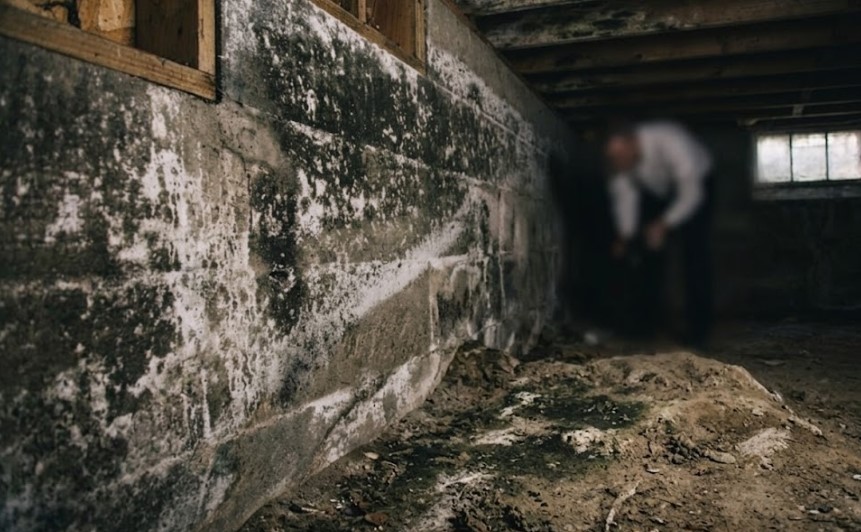
Why Denver Basements Get Mold
Denver Formation Clay Soil
The dark gray expansive clay underlying most of the Denver metro — known as Denver Formation clay or "Denver shale" — has very low permeability. When snowmelt saturates the surface, water can't drain quickly through the clay and instead flows laterally along the soil surface until it finds a lower pathway: your foundation wall. This clay holds moisture against concrete foundations for 4–8 weeks after snowmelt, creating sustained hydrostatic pressure that drives water through any crack or porous section.
170+ Freeze-Thaw Cycles
Every time temperatures cross 32°F — which happens 170–200 times annually in Denver — water in foundation micro-cracks expands as it freezes and contracts as it thaws. This is one of the key factors explained in our Denver climate & mold risk guide. Each cycle slightly widens these cracks. After 20–30 years of this cycle, a 1970s-era Denver basement has foundation walls with thousands of moisture pathways that simply didn't exist when the home was new.
Window Well Accumulation
Window wells are designed with drainage gravel at the bottom, but over decades this gravel becomes clogged with debris. When this happens during snowmelt events, window wells fill with water and create a direct hydrostatic pressure point against basement windows — one of the most common moisture intrusion pathways in Denver homes.
Signs of Basement Mold in Denver Homes
- White powdery deposits on concrete walls (efflorescence — indicates water migration through the wall)
- Musty odor that intensifies during snowmelt season (March–May)
- Dark staining on drywall at or below grade level
- Rust stains around window well frames
- Soft spots in finished basement drywall
- Visible black, green, or gray colonies on framing, insulation, or drywall
Preventing Basement Mold: What Actually Works
- Window well covers: Clear polycarbonate covers prevent water accumulation in window wells during snowmelt and rain. Simple and inexpensive ($50–$150 per well) — one of the highest-ROI mold prevention measures for Denver homes.
- Foundation crack injection: Polyurethane foam injection seals active leaking cracks from the inside without excavation. Epoxy injection is for structural cracks. Cost: $300–$800 per crack; far less than mold remediation.
- Negative grading correction: If soil has settled to slope toward the foundation, grading correction (adding and compacting soil away from the foundation) reduces surface water infiltration. A $500–$1,500 grading job can prevent thousands in foundation moisture damage.
- Dehumidifier in unfinished basements: A 70-pint dehumidifier set to 50% RH, draining to a floor drain, removes continuous moisture that would otherwise condense on cold surfaces. Run continuously April–September.
- Sump pump with battery backup: Battery backup ensures the pump continues operating during power outages — which often coincide with the heavy precipitation events that drive Denver basement flooding.
Unfinished vs. Finished Basement: Cost and Decision Differences
| Unfinished Basement | Finished Basement | |
|---|---|---|
| Typical remediation cost | $1,500–$5,000 | $5,000–$25,000+ |
| Why more expensive (finished) | — | Drywall, flooring, insulation, cabinetry must be demolished before mold can be treated — and rebuilt after |
| Mold detection difficulty | Easier — framing and concrete are visible | Harder — mold often hidden behind drywall for months before detection |
| Encapsulation viable? | Yes for concrete surfaces; no for framing mold | No — drywall with mold must be removed |
| Decision threshold | Visible mold on framing: professional basement mold remediation; efflorescence only: waterproofing + dehumidifier | Any mold behind or on finished surfaces: professional remediation required |
Prices shown are examples only. For an accurate quote, call (720) 964-0332 — free specialist consultation.
Professional Remediation Process
IICRC S520-compliant basement mold remediation involves: (1) containment with 6-mil poly sheeting and negative air pressure; (2) HEPA vacuuming of mold colonies; (3) removal of contaminated materials (drywall, insulation, carpet); (4) structural drying; (5) application of EPA-registered antimicrobial; (6) clearance air testing. At Denver's 5,280 ft altitude, HEPA filtration and dehumidification equipment specifications must account for 17% less dense air than sea level — meaning lower-rated equipment will underperform.