
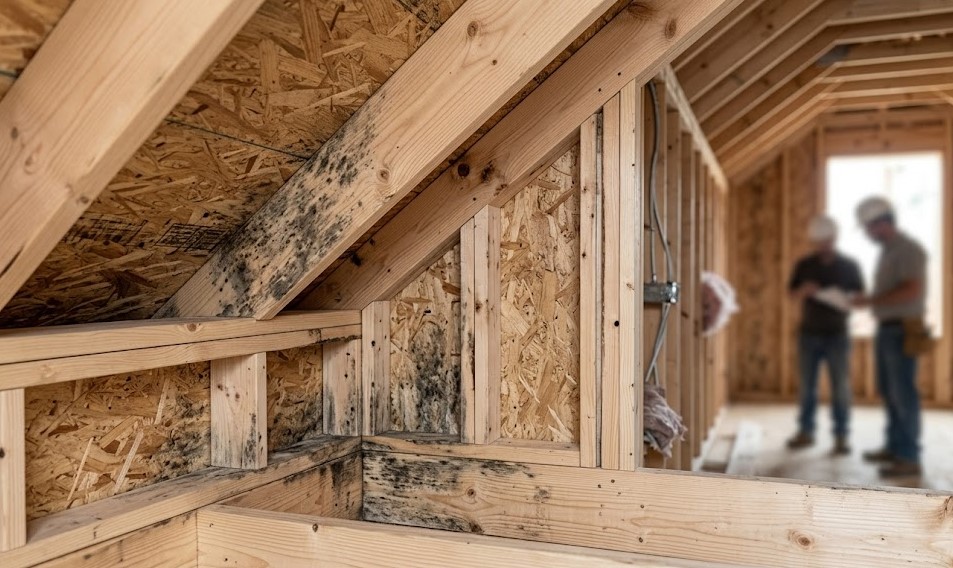
The Construction-Phase Moisture Problem
Home construction in the Denver metro proceeds year-round, but the highest-risk period for construction-phase mold is March through June — Colorado's spring season. This period combines two factors: peak precipitation risk (Denver's wettest months are April–June), and the most intensive framing and sheathing activity as builders race to deliver homes before summer price windows close.
When structural lumber, OSB sheathing, and I-joists are wetted by rain or snow during framing — and drywall installation begins before adequate drying — moisture is sealed inside wall and floor assemblies where it supports mold growth in the dark, still air of wall cavities. The first sign is typically a musty odor in the home within months of move-in, or visible staining on drywall from the inside as moisture migrates outward.
The COVID-Era Construction Boom Legacy
Denver's construction boom of 2020–2023 added tens of thousands of new homes to the metro area during a period of supply chain stress and labor shortages. Accelerated build timelines, reduced quality control oversight, and pressure to deliver homes quickly created conditions where construction-phase drying was often inadequate. Many of these homes — now 2–5 years old — are only now showing the mold consequences of improper drying during construction.
First-Winter Humidifier Mistakes
New Denver homeowners frequently overcalibrate their whole-home humidifier in the first winter. Moving from a non-Denver climate (or a home without a whole-home humidifier), they experience the dry air and set the humidifier to maximum — delivering 45–55% relative humidity at outdoor temperatures of 0–20°F. This creates condensation on cold structural surfaces and attic sheathing, producing mold in the first heating season of occupancy.
Moisture Content Standards for New Construction Acceptance
These are the moisture content thresholds that materials should meet before enclosure — i.e., before drywall is installed over them. If you're doing a pre-closing inspection or fighting a builder warranty claim, these numbers are the professional standard:
| Material | Acceptable MC Before Enclosure | What Exceeding Means |
|---|---|---|
| Dimensional lumber (framing) | <19% moisture content (MC) | Shrinkage, mold risk in wall cavity; IICRC S520 considers >19% MC a significant mold risk condition |
| OSB sheathing | <16% MC | Swelling, delamination, mold on surface |
| Drywall (gypsum board) | <1% WME (wood moisture equivalent) | Paper facing supports mold growth; gypsum core deteriorates |
| Engineered I-joists | <19% MC | Delamination of OSB web; mold in floor assembly |
A licensed home inspector or mold inspector with a professional-grade moisture meter (e.g., Delmhorst or Tramex) can verify these readings before closing — this is the most objective way to assess whether construction-phase drying was adequate.
Colorado Builder Warranty: What You're Entitled To
Colorado's Construction Defect Reform Act (House Bill 07-1338) establishes a tiered warranty that applies to new residential construction:
- 1-year warranty: Labor and materials — includes workmanship defects such as improper moisture management during construction
- 2-year warranty: Plumbing, electrical, and mechanical systems — includes HVAC commissioning failures
- 10-year warranty: Major structural defects — includes foundation issues that contribute to moisture intrusion
Mold resulting from construction-phase moisture problems (inadequate drying before enclosure) typically falls under the 1-year workmanship warranty. Mold from a structural foundation defect may fall under the 10-year warranty. Document your discovery date carefully — the clock starts when the defect was or should have been discovered.
If You Find Mold After Move-In: Steps with Your Builder
- Document everything immediately: Photograph all mold with date stamps. Note locations and approximate areas. Do not disturb the mold or allow the builder to remediate without a written scope of work.
- Send written notice within 30 days: Colorado law requires written notice to the builder before filing any construction defect claim. Send via certified mail to the builder's registered address (find at Colorado Secretary of State). State the defect, location, and date discovered.
- Get an independent inspection: Hire a third-party mold inspector (not the builder's inspector) to document scope and identify the moisture source. This report is your most important evidence.
- Request the builder's written remediation plan: Do not accept verbal commitments. Any remediation must be in writing with scope, timeline, and materials specified.
- Verify clearance testing after remediation: Require an independent post-remediation clearance air test — not one performed by the builder's contractor.
HOA and Condo Mold Disputes in Colorado
For condominiums and HOA communities, the Colorado Common Interest Ownership Act (CCIOA, C.R.S. § 38-33.3) governs responsibility for mold in common elements vs. individual units. General principles:
- Mold originating from a common element (roof, exterior wall, shared plumbing) is the HOA's responsibility to remediate
- Mold originating within a unit from the owner's maintenance failures is the unit owner's responsibility
- Disputes over the source require an independent mold assessment establishing the moisture pathway
- The HOA's governing documents (Declaration, CCRs) may assign responsibility differently — review your specific documents
What to Check Before Closing on a New Denver Home
- Request the builder's moisture testing records for structural lumber before drywall installation
- Schedule a pre-closing mold inspection with moisture meter and thermal imaging
- Inspect the attic for sheathing discoloration
- Check the basement foundation walls and rim joist area for staining
- Ask about HVAC commissioning — was the humidifier calibrated to Denver altitude and outdoor temperature?