
- Musty odor — especially after snowmelt. A persistent earthy, musty smell that intensifies in spring (March–May) indicates moisture intrusion from snowmelt. The smell is strongest near floor level and in basement stairwells.
- Visible mold colonies. Black, green, gray, or white colonies on drywall, framing, insulation, or concrete. Any visible mold exceeding a 10-square-inch area requires professional assessment.
- Allergy symptoms that improve when you leave home. If residents experience persistent cough, sinus congestion, or eye irritation that improves significantly when away from home for 48+ hours, mold is a likely cause.
- Efflorescence on basement walls (#4 — don't ignore this). White, chalky powder on concrete basement walls is efflorescence — mineral deposits left by water moving through your foundation. It's not mold itself, but it's a definitive sign that water is migrating through your walls, creating conditions for mold on adjacent wood and drywall.
- Window well rust stains. Orange or brown rust staining around basement window frames indicates chronic moisture at the window well — a common mold entry point in Denver homes.
- Buckling or soft drywall at or below grade level. Drywall that feels soft, bows outward, or shows dark staining at the base of below-grade basement walls contains moisture and likely mold within its paper facing.
- HVAC odor when system runs. A musty smell specifically when the furnace or AC turns on indicates mold in the air handler, evaporator coil, or ductwork — typically from humidifier overcalibration in Denver.
- Discoloration on attic sheathing. Dark gray or black staining on OSB or plywood roof sheathing visible from the attic hatch indicates either ice dam intrusion or excess humidity from a miscalibrated whole-home humidifier rising into the attic.
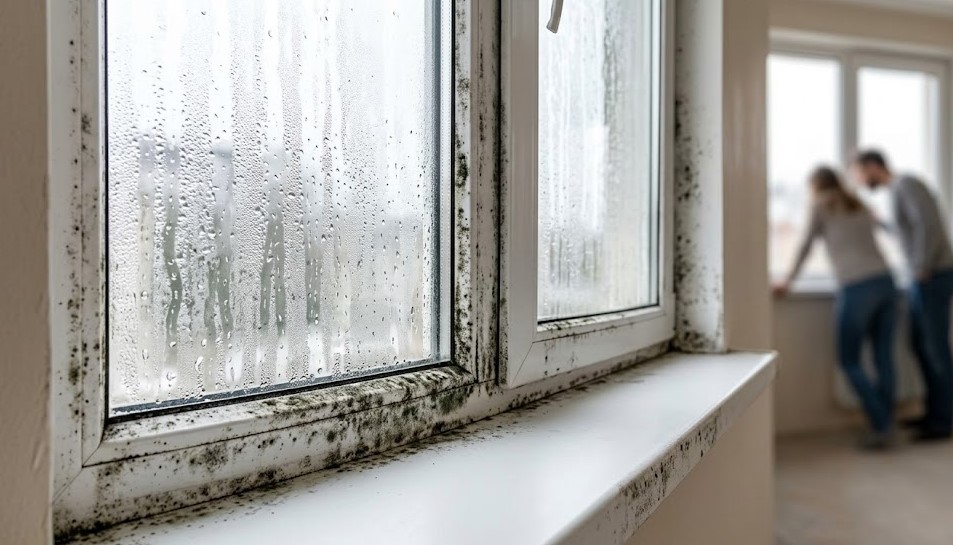
- Condensation on windows during winter. Condensation on interior window surfaces during cold weather means indoor humidity is too high for the outdoor temperature — the same excess humidity that causes mold on cold structural surfaces.
- Recurring basement flooding during March–May. Repeated snowmelt flooding — even without visible mold — creates cumulative moisture damage in framing, insulation, and drywall that eventually produces mold even if individual events are dried quickly.
Mold vs. Mildew vs. Mineral Deposits
These three are the most frequently confused in Denver homes — and mistaking one for another leads to either unnecessary panic or a missed mold problem.
| Mold | Mildew | Efflorescence (minerals) | |
|---|---|---|---|
| Color | Black, green, gray, white, or orange — varies by species | White or light gray, powdery | White, chalky, crystalline |
| Texture | Fuzzy, slimy (Stachybotrys), or powdery depending on species | Flat and powdery, stays on surface | Crumbles and flakes easily |
| Where found | Any porous or non-porous wet surface; inside walls | Shower grout, tile, bathroom surfaces | Concrete or masonry walls only |
| Smell | Musty, earthy — often strong, lingering | Mild musty odor | No odor |
| Bleach reaction | Lightens quickly but returns on porous materials | Lightens and typically stays gone | No reaction |
| Health risk | Yes — respiratory, allergic, mycotoxins (some species) | Minimal in small amounts | None (but indicates water intrusion) |
| Next step | Professional assessment if >10 sq ft or on porous material | DIY cleaning acceptable for small bathroom areas | Find and fix the moisture source |
Room-by-Room Self-Inspection Checklist
Before calling a professional, do a 20-minute walkthrough using this checklist. Photograph every "yes" — this documentation is useful for insurance and contractor estimates.
| Room / Area | What to Check |
|---|---|
| Basement | White powder on concrete walls (efflorescence); dark staining at base of drywall; soft or spongy drywall; rust around window frames; musty odor (especially in spring); visible black/green/gray growth on framing or insulation |
| Bathroom | Black or pink discoloration in tile grout; soft, stained, or separating caulk; cabinet floor under sink (soft, stained, odor); drywall around tub/shower (soft spots, bubbling paint); odor behind toilet base |
| Kitchen | Under-sink cabinet: water stains, soft floor panel, musty odor; behind/under refrigerator: condenser area; around dishwasher edges; window sills condensation staining |
| Attic | Dark gray or black staining on OSB or plywood sheathing (view from hatch); staining on rafters or ridge board; wet, discolored, or compressed insulation |
| HVAC / Mechanical | Musty smell when system first turns on; black residue around supply registers; visible staining inside air handler access panel; humidifier water panel — brown or black buildup |
| Exterior walls (from inside) | Bubbling or peeling paint on exterior-facing walls; staining near window frames; soft drywall; condensation rings or tide lines on surfaces below windows |
| Crawl space | White or gray growth on floor joists (view with flashlight); wet or torn vapor barrier; standing water or moisture on dirt floor; insulation hanging down |
How Urgently Do You Need to Act?
| What You Found | Urgency | Why |
|---|---|---|
| Visible colony >10 sq ft; slimy black growth in wet area; anyone in home has respiratory symptoms | Act within 24 hours | Likely active Stachybotrys or large colony — spore count rising; potential health risk |
| Visible colony <10 sq ft on drywall or wood; musty HVAC odor; soft drywall | This week | Active growth into porous materials — grows daily if moisture remains |
| Efflorescence; window well rust; seasonal musty odor; window condensation | This month | Moisture pathway confirmed; mold not yet established but conditions are right |
| Attic sheathing staining (old, dry); allergy improvement when away from home; mild HVAC odor | Schedule inspection | Possible hidden or historical mold; professional assessment will confirm |
Detection & Identification Topic Cluster
Found signs of mold? Follow these guides in order:
Mold has a musty, earthy odor often described as similar to wet cardboard or soil. In Denver basements, this smell is most noticeable after snowmelt season (March–May). The odor may intensify after running the HVAC system if mold is present in ductwork.
White powder on concrete basement walls is efflorescence — mineral deposits left behind as water migrates through concrete. Efflorescence itself is not mold, but it indicates water is moving through your foundation, which creates conditions for mold on adjacent wood and drywall.