
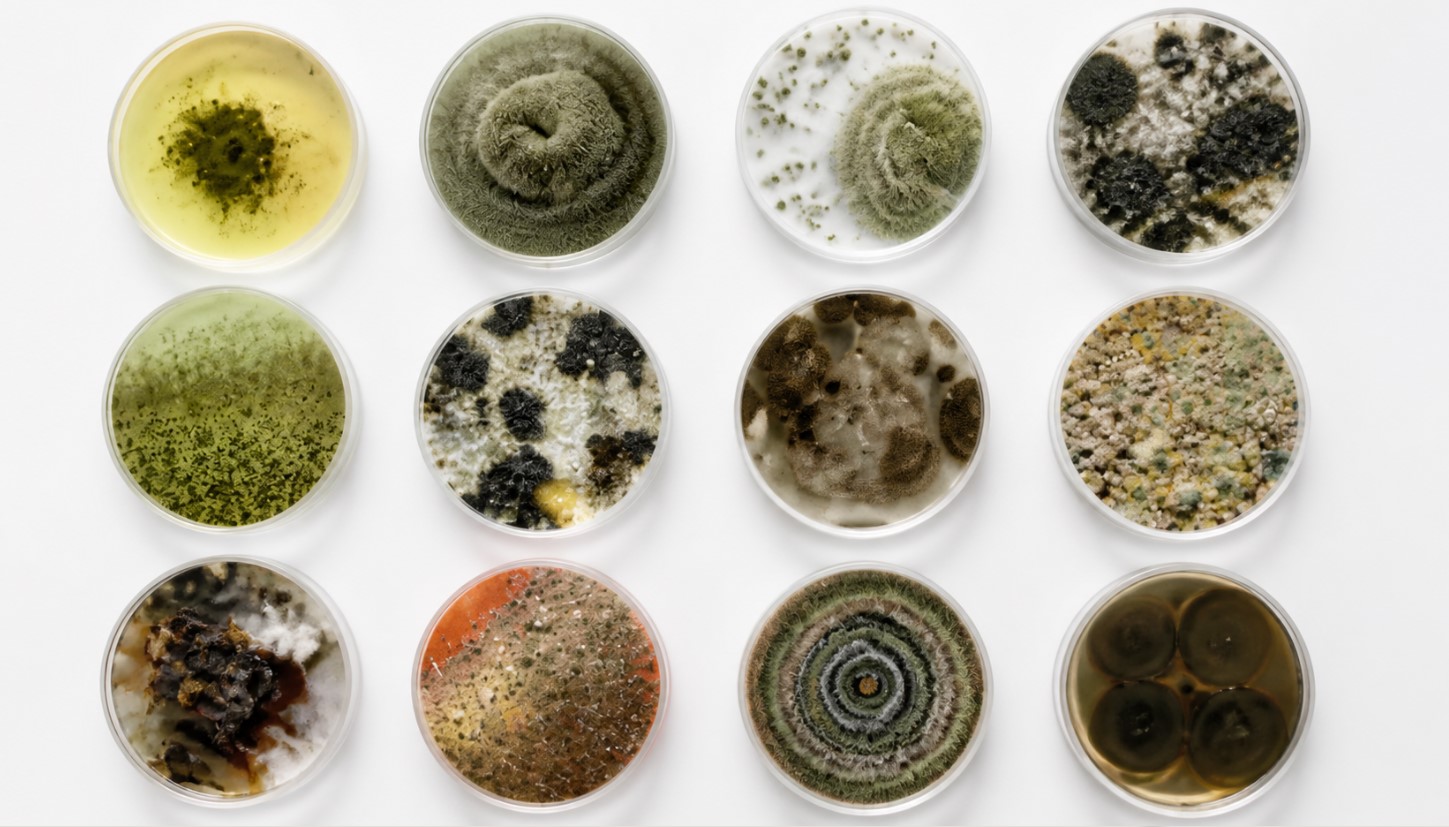
Cladosporium — Colorado's Most Common Indoor Mold
Appearance: Olive green to black, powdery texture
Where it grows: Basement walls, window frames, HVAC ducts, attic sheathing, bathroom grout
Colorado context: Cladosporium is the dominant outdoor mold spore in Colorado and grows well at cooler temperatures — making it well-adapted to Denver's basements (which stay 55–65°F year-round) and attics following ice dam intrusion. It's routinely found in Colorado outdoor air samples.
Health effects: Respiratory irritation, allergic reactions; rarely serious in healthy adults
Penicillium / Aspergillus — HVAC and Water-Damage Specialists
Appearance: Blue-green, sometimes white or yellow; powdery and fast-spreading
Where it grows: Water-damaged drywall, HVAC system components (evaporator coil, humidifier panel), insulation, stored organic materials
Colorado context: Penicillium and Aspergillus species are among the most commonly identified molds in Denver HVAC systems — particularly in whole-home humidifier pans and evaporator coil faces. They spread rapidly on water-damaged drywall after snowmelt flooding.
Health effects: Respiratory irritation; some Aspergillus species produce mycotoxins; serious infections possible in immunocompromised individuals
Stachybotrys chartarum — True "Black Mold"
Appearance: Slimy, greenish-black; NOT powdery or dry
Where it grows: Areas with sustained moisture for 7–14+ days: basement framing after prolonged snowmelt flooding, drywall behind chronic leaks, bathroom subfloors with long-term toilet wax ring failures
Colorado context: Less common than Cladosporium or Penicillium because Stachybotrys requires chronically wet conditions — which Denver's dry climate usually limits. However, Colorado's snowmelt flooding events and burst pipe incidents during cold snaps create exactly the sustained moisture Stachybotrys needs.
Health effects: Produces trichothecene mycotoxins; most serious health effects of any common indoor mold
Alternaria — Shower and Window Specialist
Appearance: Dark brown to black, velvety
Where it grows: Shower stalls, bathroom sinks, window sills, below leaking windows
Colorado context: Common in Denver bathrooms where shower steam condenses on cold tile and grout. Window condensation during Denver winters (when outdoor temperatures are -5°F and indoor humidity is overcalibrated) also supports Alternaria growth on window frames.
Health effects: Allergic reactions; asthma trigger
Chaetomium — After Denver Water Damage
Appearance: White initially, becoming gray and then olive-brown to black as it matures; has a musty smell often described as "dirty socks"
Where it grows: Water-damaged drywall, paper, cardboard, baseboards, and wood after sustained wetting; common after Denver basement flooding events
Colorado context: Frequently found after the prolonged drywall wetting that accompanies snowmelt flooding in Denver basements. Unlike Stachybotrys (which requires chronically wet conditions), Chaetomium establishes more readily after moderate water damage events.
Health effects: Produces chaetoglobosins, which are mycotoxins; associated with neurological effects and nail infections in some research; generally considered a marker of significant water damage history
Species Comparison Summary
| Species | Color | Common Location | Requires Chronic Moisture? | Remediation Approach |
|---|---|---|---|---|
| Cladosporium | Olive green to black | Basement walls, attic, window frames | No — tolerates cool, damp conditions | Standard IICRC S520 protocol |
| Penicillium / Aspergillus | Blue-green, sometimes yellow | HVAC, water-damaged drywall, insulation | No — any wet surface | Standard protocol; HVAC disinfection |
| Stachybotrys | Slimy greenish-black | Chronically wet drywall, wood | Yes — 7–14+ days sustained wetting | Full physical removal of affected material; no encapsulation |
| Alternaria | Dark brown to black, velvety | Showers, sinks, window sills | No — surface condensation sufficient | DIY possible on tile; professional if on porous material |
| Chaetomium | White → olive-brown → black | Water-damaged drywall, baseboard, paper | No — moderate water damage sufficient | Physical removal of affected drywall and materials |
Does the Species Change How Mold Is Remediated?
In most cases, no — the IICRC S520 remediation protocol applies regardless of species: contain the work area, physically remove affected porous materials, apply EPA-registered antimicrobial to treated surfaces, verify with clearance air testing. The goal is to remove the mold, not to specifically target a species.
The one significant exception is Stachybotrys chartarum: because it produces trichothecene mycotoxins that can be present in the material even after the mold colony is killed, IICRC S520 specifically requires full physical removal of any Stachybotrys-contaminated material. Encapsulation — sealing rather than removing — is not acceptable for Stachybotrys.
How to Read a Lab Report Spore Count
When your inspector provides an air sampling report, you'll see spore concentrations reported in spores/m³. Here's how to interpret the numbers:
- Compare indoor to outdoor control sample: Every valid air sample report includes a simultaneously collected outdoor (control) sample. An indoor spore count is only concerning if it significantly exceeds the outdoor count — or if it contains species in proportions different from outdoor air (e.g., 80% Stachybotrys indoors vs. 0% in outdoor control).
- Species composition matters more than total count: A high total spore count dominated by Cladosporium (which is abundant outdoors in Colorado) may be normal. A lower total count with an unusual species mix (Stachybotrys, high Chaetomium, or Aspergillus/Penicillium far exceeding outdoor levels) is more actionable.
- There are no EPA or Colorado state "safe" thresholds: The absence of a regulatory standard does not mean any count is acceptable. Elevated relative counts of concern species should be evaluated by your inspector.
- Altitude correction: Confirm your inspector applied an altitude correction to the pump flow rate. An uncorrected Denver sample may show counts up to 17% lower than actual.
Health effects from mold vary significantly based on the species, exposure duration, and individual health status. The information in this article is for general awareness only and is not a substitute for medical advice. If you or a family member are experiencing symptoms that may be related to mold exposure, consult a licensed healthcare provider.