
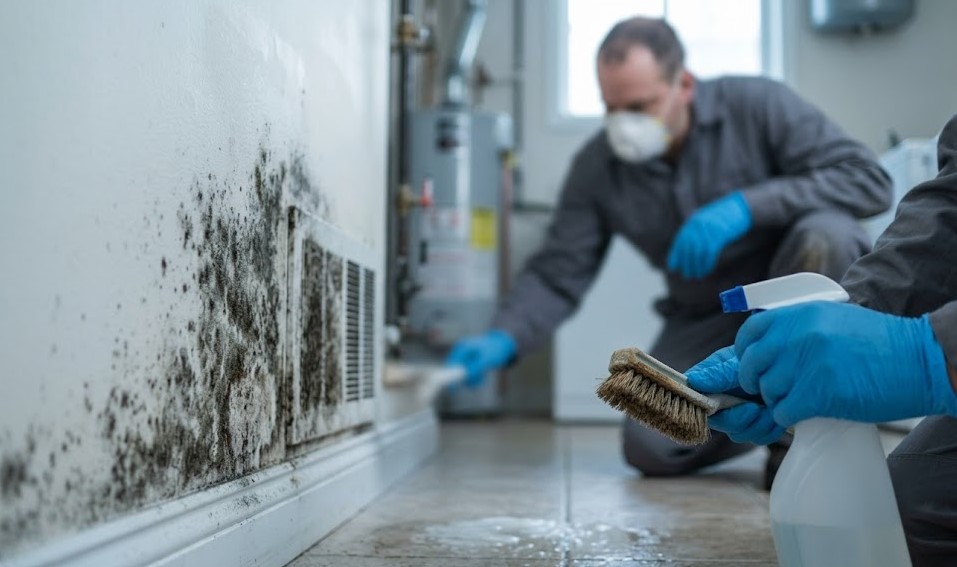
When DIY Is Acceptable
The EPA's mold remediation guidance identifies DIY as acceptable when:
- The mold patch is smaller than 10 square feet (roughly 3 ft × 3 ft)
- The mold is on a non-porous surface (tile, glass, metal, painted concrete)
- The moisture source has been identified and corrected
- No household members have respiratory conditions, allergies, or compromised immune systems
- The mold is not in HVAC systems, inside wall cavities, or in attic/crawl space framing
For DIY removal: wear N95 respirator, nitrile gloves, and eye protection. Use an EPA-registered antimicrobial product — not bleach on porous surfaces. Seal off the work area from the rest of the home.
When You Must Call a Professional
- Mold area exceeds 10 square feet
- Mold is on porous materials: drywall, wood framing, OSB sheathing, insulation
- Any basement or crawl space mold after snowmelt flooding
- Mold in HVAC system, ductwork, or air handler
- Visible black or dark green slimy mold (suspected Stachybotrys)
- Mold behind walls, in attic, or in other concealed spaces
- Any household member experiencing health symptoms
- Pre-purchase or pre-sale mold for real estate transaction documentation
Step-by-Step: DIY Mold Removal from Tile and Grout
If the mold is in a bathroom — on tile, grout, or caulk — and meets all the DIY criteria above, here's how to do it correctly:
- Gather materials: N95 respirator, nitrile gloves, safety glasses, old clothes or a disposable Tyvek suit, EPA-registered mold cleaner (see products below), stiff grout brush, paper towels, heavy-duty trash bags.
- Ventilate the room: Open a window and run the exhaust fan. If there's no exhaust fan, aim a box fan outward through the window to pull air out of the room — away from the rest of the house.
- Seal the drain: Lay a damp paper towel over the drain to prevent spores from entering the plumbing and spreading.
- Apply the cleaner: Spray the EPA-registered product directly on the affected grout and tile. Follow the dwell time on the label — typically 3–10 minutes. Do not rinse immediately.
- Scrub with a grout brush: Use moderate pressure on grout lines. For tile surfaces, a scrub pad is sufficient. Avoid creating excessive spray and aerosolizing spores.
- Wipe and discard: Wipe away residue with disposable paper towels. Place all used paper towels directly into a heavy-duty trash bag and seal immediately.
- Rinse and dry: Rinse the area with clean water. Dry thoroughly with a clean towel or fan. Do not leave surfaces wet.
- Replace caulk if needed: If mold has penetrated silicone caulk (black discoloration that doesn't clean off), remove all old caulk, allow the area to dry completely for 24–48 hours, and re-caulk with a mold-resistant silicone product.
- Fix the moisture source: If tile mold keeps returning, the real problem is usually insufficient ventilation (exhaust fan not strong enough or not used consistently), or a shower door seal that holds water. Fix the source — not just the symptom.
Time required: 30–60 minutes. Material cost: $40–$120.
DIY vs. Professional: Cost Comparison
| DIY | Professional | |
|---|---|---|
| Typical cost | $40–$120 (materials only) | $300–$1,500 (small jobs); $3,000–$10,000+ (large/structural) |
| Appropriate for | Non-porous surfaces, <10 sq ft, no porous material involved | Drywall, wood, insulation, HVAC, >10 sq ft, structural mold |
| Equipment needed | N95, gloves, EPA product, brush | HEPA air scrubbers, negative pressure, containment, PPE, lab testing |
| Documentation | None | Written report, clearance test — usable for insurance/real estate |
| Guarantee | No formal guarantee | Written warranty and clearance testing (IICRC S520) |
Prices shown are examples only. For an accurate quote, call (720) 964-0332 — free specialist consultation.
EPA-Registered Products for DIY Mold Removal
Use only EPA-registered antimicrobials — not household bleach on porous surfaces. These products are commonly available in Denver-area home improvement stores:
- Concrobium Mold Control — no harsh fumes, safe on most surfaces including wood; uses a physical crushing mechanism as it dries. Good choice for limited ventilation areas.
- RMR-86 Instant Mold Stain Remover — highly effective stain remover for non-porous surfaces; contains sodium hypochlorite, requires good ventilation. Do not use on bare wood or drywall.
- Foster 40-80 (Sta-Clean) — professional-grade antimicrobial; often used by contractors on treated surfaces after remediation. Available at janitorial supply stores.
- Bio-Fresh Mold Remover — lower-fume alternative; suitable for tile, grout, and sealed surfaces.
For wood or porous surfaces where mold cannot be physically removed, use a product rated for porous surface mold treatment and follow with an encapsulant like Zinsser Mold Killing Primer before repainting.
Common DIY Mistakes That Make Mold Worse
- Dry-scrubbing without containment — agitating dry mold without sealing the area sends spores throughout the home. Always dampen the area with cleaner first and work in a sealed space.
- Using a shop-vac without a HEPA filter — standard vacuum exhausts spores back into the air. If you use a vacuum, it must have a HEPA filter.
- Painting over mold — mold-resistant paint does not kill existing mold. It only prevents future growth on clean surfaces. Painting over mold traps it and allows it to continue growing underneath.
- Not fixing the moisture source — the single most common reason mold returns within weeks of DIY treatment. Mold is a symptom of moisture; treat the cause, not just the surface.
- Using bleach on wood or drywall — see the section above. The water in bleach adds moisture to the material while leaving mold roots alive.
- Removing ceiling tiles from a water-stained area without checking the attic — the visible mold is often only a fraction of the problem. Hidden mold in the structure above may be significant.
The Bleach Myth
Bleach is widely recommended for mold — but it's only effective on non-porous surfaces. On wood, drywall, and other porous materials, the water in bleach penetrates while the chlorine stays on the surface. This leaves the mold's root structure (hyphae) alive in the material while appearing clean on the surface. Mold returns within weeks. On porous surfaces, use EPA-registered products specifically formulated for porous surface mold remediation.