
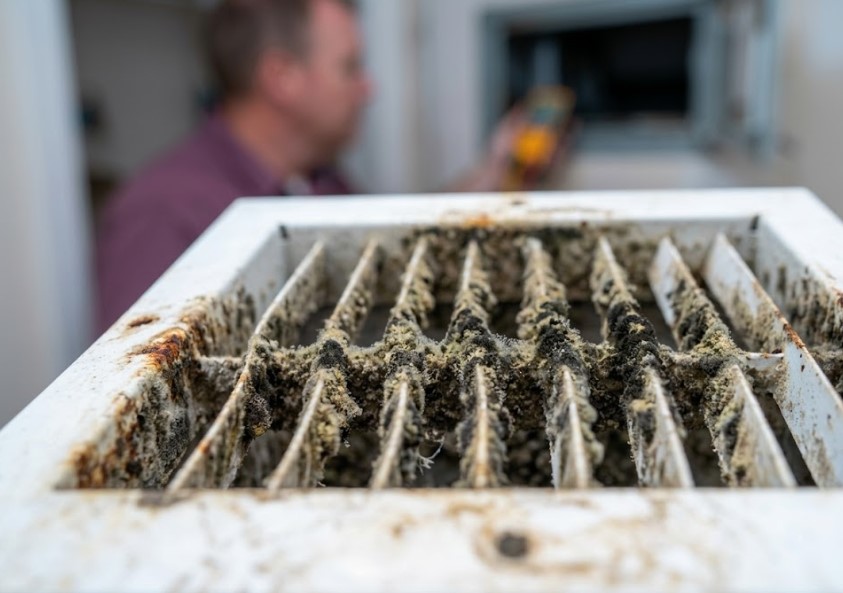
Why Denver Humidifiers Create Mold Risk
Whole-home humidifiers (bypass, fan-powered, or steam types) are installed on forced-air HVAC systems to add moisture to dry indoor air. Denver's outdoor humidity often drops below 20% in winter, creating uncomfortable static, respiratory dryness, and wood shrinkage. Humidifiers are necessary — but they must be calibrated to match outdoor temperature.
The physics: when indoor humidity is too high relative to outdoor temperature, moisture condenses on cold surfaces (exterior walls, rim joists, attic sheathing, cold duct sections). This condensation creates the localized >70% relative humidity that mold requires to colonize surfaces.
Correct Denver Humidifier Settings
| Outdoor Temperature | Max Indoor RH | Mold Risk if Exceeded |
|---|---|---|
| Above 20°F | 35% | Condensation on exterior walls |
| 10°F to 20°F | 30% | Window frame & sill mold |
| 0°F to 10°F | 25% | Rim joist & band joist mold |
| Below 0°F | 20% | Attic sheathing & rafter mold |
Where Humidifier Mold Grows
- Humidifier water panel: The evaporator pad itself supports scale and mold colonization — annual replacement required
- Drain pan: Standing water in the humidifier drain tray
- Air handler cabinet: Evaporator coil and adjacent cabinet walls when coil is cold and humidity is high
- Flexible ductwork sags: Condensate pools in low points
- Rim joist and band joist: Cold exterior framing condenses excess indoor humidity
- Attic floor framing: Humid air bypasses insulation and contacts cold sheathing
Humidifier Types: Mold Risk Comparison
| Type | How It Works | Mold Risk | Notes for Denver |
|---|---|---|---|
| Bypass humidifier | Draws warm air through a water-soaked pad when the furnace runs; excess drains | Moderate — water panel colonizes if not replaced annually; drain line clogs create standing water | Most common in Denver homes; proper pad replacement each October is essential |
| Fan-powered humidifier | Same as bypass but with its own fan — runs independent of furnace blower | Moderate-high — runs more frequently, delivers more humidity; overcalibration risk higher | Better moisture delivery but requires more careful humidistat management in Denver cold snaps |
| Steam humidifier | Boils water to produce steam; no pad | Low for the unit itself — no water panel mold; but delivers most moisture, so structural mold risk highest if miscalibrated | Highest output type; most effective for Denver dry air but most consequential if set too high |
| Portable/room humidifier | Tank and wick or ultrasonic; room-level output | High for the unit itself — tanks become contaminated within days without daily cleaning | Acceptable for targeted use; do not use in basements or rooms with existing moisture problems |
How to Check If Your Humidifier Has Mold Right Now
Inspect these components before the start of each heating season (September–October):
- Water panel / evaporator pad: Remove and examine. A healthy pad is tan or white with mineral deposits. Discard if you see black, green, or gray growth — do not attempt to clean; replace.
- Drain tray: Look inside the humidifier body at the bottom tray. Any standing water with sliminess or discoloration indicates active biofilm or mold. Clean with an EPA-registered antimicrobial and ensure the drain line is clear.
- Drain line: Disconnect and check for algae or mold buildup. Run water through it. A blocked drain causes standing water — the primary mold vector in bypass humidifiers.
- Air handler interior (if accessible): Open the air handler access panel. Look at the evaporator coil and adjacent plenum surfaces. Dark staining, especially on coil fins or coil face, indicates mold and requires professional HVAC mold removal.
Smart Humidistat Recommendations for Denver
A smart humidistat that reads both indoor humidity and outdoor temperature — and automatically adjusts output — eliminates the single biggest human error in humidifier management. Two models commonly recommended by Denver HVAC technicians:
- Aprilaire 8910W: Reads outdoor temperature via sensor and automatically limits indoor humidity to prevent condensation. Compatible with most Aprilaire and some third-party humidifiers. Replaces manual humidistat entirely.
- Honeywell Home HumidiPRO H6062A: Wi-Fi enabled humidistat with outdoor temperature sensing; allows remote adjustment via app. Works with most Honeywell bypass and fan-powered humidifiers.
Either device eliminates the need to manually adjust the humidistat when outdoor temperatures change — a task most Denver homeowners do not do consistently, which is why overcalibration and mold are so common.
5 Questions to Ask Your HVAC Tech at Annual Service
- "Can you replace the humidifier water panel while you're here?" — Annual replacement; many techs skip this unless asked.
- "Is my humidistat set correctly for Denver temperatures?" — Ask them to verify the setting against the outdoor temperature table above.
- "Did you inspect the drain tray and drain line?" — A clogged drain is the most common cause of bypass humidifier mold.
- "Did you see any signs of mold or unusual buildup in the air handler?" — Ask for this explicitly; it's not always volunteered.
- "Would my system benefit from a smart outdoor-sensing humidistat?" — Worth asking if you have an older manual humidistat.
Annual Maintenance That Prevents Mold
- Replace the humidifier water panel/evaporator pad each October
- Inspect and clean the drain tray and drain line
- Set the humidistat according to the outdoor temperature chart above
- Schedule HVAC coil cleaning every 2–3 years
- Inspect rim joist insulation for moisture staining each spring